

Maggie Wu (吳詩敏)[1] Lin Tzu-Ching (林子靖)[2]
Taiwanese law contains no express provision on whether an unmanned vessel is a “ship”, and one and the same unmanned boat may yield different answers depending on the legal question asked. This series is divided into six parts. This part explains the positioning problem that arises once the Unmanned Vehicle Act takes effect, sets out the Shipping Act’s definition of a ship and the vessels it excludes, and compares the terminology the maritime authority uses for unmanned vehicles, for the reference of the unmanned vehicle industry.
Positioning once the Unmanned Vehicle Act takes effect
The Act for Strengthening National Defense Self-Reliance and Promoting the Unmanned Vehicle Industry (強化國防自主暨無人載具產業發展條例; unofficial translation, “the Unmanned Vehicle Act”) was promulgated on 11 September 2026; except for Article 4, which took effect upon promulgation, its provisions take effect on 11 March 2027. Under Article 3, subparagraph 1, an unmanned vehicle is equipment whose operation does not require personnel to be carried on board the machine itself and which can be operated by remote control, autonomous control or other means in the air, on the water surface, underwater, on land or in other environments. Article 17, paragraph 2 further provides that the Ministry of National Defense shall procure “the three items of littoral surveillance and reconnaissance UAVs, littoral attack UAVs and small suicide unmanned boats for the armed forces”. Once the Act is in force, budget and procurement demand for surface and underwater unmanned vehicles can be expected to become more stable.[3]
The Shipping Act (船舶法), however, contains almost no corresponding provision for unmanned vessels. Whether an unmanned vessel is a ship determines not only whether it must be registered, surveyed and crewed, but also which rules apply when it enters a port area. Nor is there a single answer: the same unmanned boat may yield different conclusions depending on the legal question at issue (Figure 1).
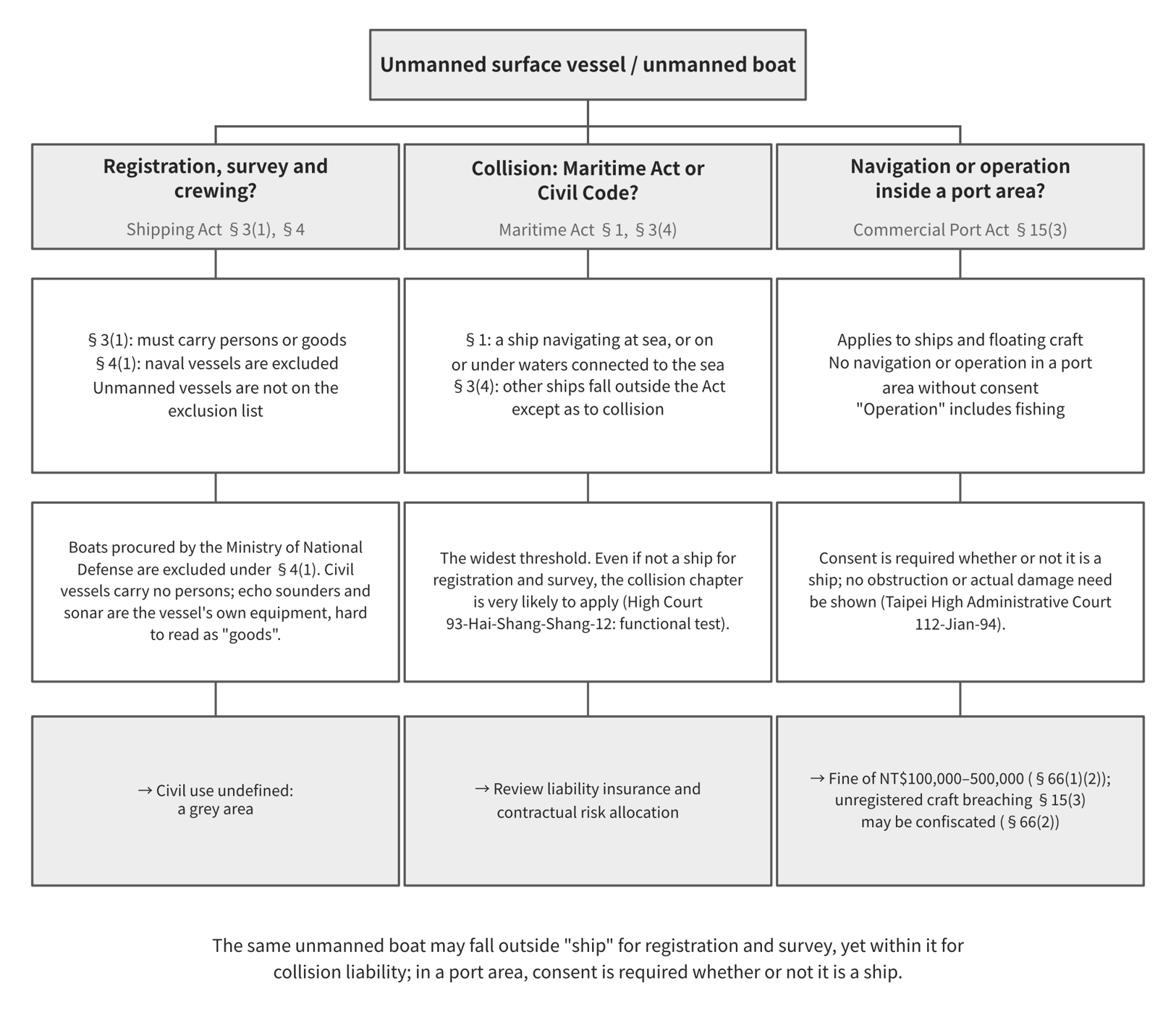
Figure 1 Three lines of analysis for the legal position of an unmanned vessel
The Shipping Act as it stands
(1) The definition of a ship
Article 3, subparagraph 1 of the Shipping Act (船舶法) provides: “Ship: a movable waterborne vehicle that carries persons or goods on or under the water, including passenger ships, cargo ships, fishing vessels, special purpose ships, yachts and small ships.” An unmanned vessel is by design not intended to carry persons; an unmanned vessel used for hydrographic survey or port inspection carries echo sounders, sonar or imaging equipment, and such equipment is part of the vehicle’s own fit-out. Reading it as “goods” is, on the ordinary meaning of the words, a considerable stretch.
It is worth noting that the two statutes define their subject in exactly opposite directions: the Unmanned Vehicle Act identifies an unmanned vehicle by the fact that no personnel need be carried on board, whereas the Shipping Act (船舶法) identifies a ship by the carriage of persons or goods.
The two sets of administrative guidance later issued by the maritime authority for unmanned vehicles — the Safety Management Guidelines for Unmanned Surface and Underwater Vehicles in Designated Test Waters and the General Safety Management Guidelines for Unmanned Surface and Underwater Vehicles, the content of which is set out in Part Five — adopt the same approach. The General Safety Management Guidelines define an unmanned surface vehicle as “a vehicle that operates by system decision-making or remote operation, moves on the water surface under propulsion power, and does not carry persons or goods”; the Designated Test Waters Safety Management Guidelines define it as “a surface vehicle carrying no persons and no goods, movable on the water surface and having propulsion power, which can be operated by remote control or autonomously”. On the question whether persons or goods are carried, the wording of the Shipping Act (船舶法) and the wording the maritime authority uses for unmanned vehicles are exact mirror images.[4]
(2) Vessels excluded from the Act
Article 4 of the Shipping Act (船舶法) lists the vessels to which the Act does not apply: naval vessels of military establishment; dragon boats, canoes and non-powered sailing boats; public small ships stationed ashore by fire-fighting and disaster relief agencies; non-fishing small ships with propulsion power of less than 12 kW; and small ships or floating craft used by indigenous peoples (extract). Unmanned vessels are not on the list.
If an unmanned vessel is first characterised as a small ship, however, a small electric unmanned boat with propulsion power of less than 12 kW may fall outside the Shipping Act under subparagraph 4 of that article. Two vessels that are both unmanned may therefore reach different conclusions according to hull type and propulsion power.
By way of comparison, the thresholds the maritime authority has adopted for unmanned vehicles are not aligned with those in the Shipping Act (船舶法). The General Safety Management Guidelines expressly do not apply to vehicles with propulsion power of less than 3 kW or a maximum length of 2 metres or less, and divide unmanned surface vehicles into four classes by size and power (Class 1 being a maximum length of 24 metres or more together with power of 12 kW or more, and Class 4 a maximum length of less than 7 metres); the Designated Test Waters Guidelines likewise exclude surface vehicles of less than 3 kW or 2 metres or less. The rules applicable to one and the same unmanned boat may therefore differ as between the Shipping Act and the two sets of guidance.
Conclusion
Article 3, subparagraph 1 of the Shipping Act (船舶法) identifies a ship by the carriage of persons or goods, which runs in exactly the opposite direction from the Unmanned Vehicle Act’s “no personnel carried on board”; the maritime authority’s administrative guidance likewise uses the formula “does not carry persons or goods”. The exclusion list in Article 4 of the Shipping Act does not mention unmanned vessels, while the guidance marks out its own scope by reference to 3 kW, 2 metres and a four-class division, so that the thresholds are not aligned. Unmanned boats for defence use are excluded under Article 4, subparagraph 1 and their position is clear; civil commercial unmanned vessels fall into a grey area of definition.
(The next part of this series asks: why do the documentary and personnel requirements in the Shipping Act and the Seafarer Act all presuppose people on board? An unmanned vessel can have no crew list and no helmsman who can undergo a medical examination — how is that dealt with in practice?)
[1] Maggie Wu (吳詩敏) is the Managing Partner of Stellex Law Firm (有澤法律事務所). LL.M., Soochow University; LL.M., Indiana University Robert H. McKinney School of Law.
[2] Lin Tzu-Ching (林子靖) is the Managing Partner of Pan & Lin, Attorneys-at-Law (則誠法律事務所). LL.M., Graduate Institute of Law and Interdisciplinary Studies, National Chengchi University; LL.M. in Environmental and Energy Law, Georgetown University Law Center.
[3] Promulgated on 11 September 2026 by Presidential Order Hua-Zong-Yi-Jing No. 11500086651. Article 24 of the Act provides: “This Act shall take effect six months after promulgation; Article 4 shall take effect upon promulgation.”
[4] Safety Management Guidelines for Unmanned Surface and Underwater Vehicles in Designated Test Waters, issued by the Maritime and Port Bureau, MOTC, by Letter Hang-Bo-Zi No. 1141711673 of 30 December 2025 and amended by Letter Hang-Bo-Zi No. 1151710667 of 14 July 2026; General Safety Management Guidelines for Unmanned Surface and Underwater Vehicles, issued by the same Bureau by Letter Hang-Bo-Zi No. 1151710748 of 24 July 2026. Both are published in the “Unmanned Vehicles Section” of the Bureau’s website (accessed 2 November 2026). Both are administrative guidance, not regulations, and carry no penalty provisions; Chapter 6 of the General Guidelines further provides that the approval documents, use certificates and remote operator certificates issued under them are, “after a dedicated statute or related legislation takes effect”, to be replaced, extended or continued in use under a conversion mechanism to be announced by the maritime authority.